Honeycomb Wall Module: Detailed manual
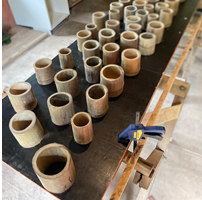
Bamboo stubs of different Ø dimensoin but with equal height, placed randomly on a board. Even split stubs work.
Bamboo stubs of the same length create an impact resistance wall.
Even broken stubs can be used if having the same length.
A wall panel 60 x 240 cm, is built flat on a bench, on top of a OSB board or similar. 60 cm is a common width for a module to be handled by two people without machinery. 240 cm is a common ceiling height, although optional. The wall thickness is also determined according to personal choice: 5, 10, 15 cm… A final module weight of max 50-60 kg is practical for the wall assembly.
Bamboo stubs are cut according to the standard wall thickness chosen and almost randomly placed on top of the OSB. The number of stubs needed depends on the density desired: if placed side by side, the impact resistance becomes extremely high, whereas if this is less needed and the number of stubs reduced by 50%, the wall could still be strong enough. A practical evaluation of different stub densities is worthwhile for project economy.
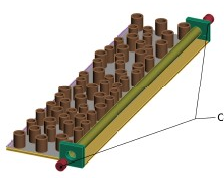
Centering the load bearing culm. Fasten it to stubs, see A3.
When positioning the stubs on the board, a 10 cm wide space is left on one of the long side edges of the module for a vertical loadbearing culm to be included later on. 3-4 stubs should line up next to this space for later fixing to the culm.
Likewise, 2-3 stubs should line up on the upper and lower sides for later fixtures to floor and ceiling.
On top of all the bamboo stubs now placed on the OSB, a fine meshed chicken net is stapled, with at least three staples on every stub. A completely flat and stiff galvanized plaster net, mesh 20x20 mm, would be better. (Although difficult to find in Brazil) The whole cluster of stubs can now be lifted off the OSB, flipped upside down and placed on the floor.
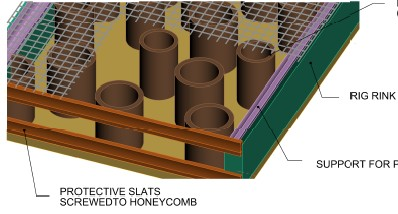
Rig rink (green), lower side here removed for viewing details.
Protective slats screwed to stubs later on.
The board must now be equipped with "rinks", lists (with a 1-2 x 4-6 cm section) fastened with screws along all the sides. Depending on the thickness of the board a rink, 2-5 cm high above the board, running along all sides will now form a pool to contain the liquid mortar mix. To achieve a smooth final surface of the wall, a plastic film is placed on the bottom of the pool also covering the rinks.
The plaster mix should now be prepared with the volumetric proportions 1 cement to 3-4 sand. The sand must be sifted to avoid gravel size stones sticking out. If color pigmenting is planned, it should now be added to the dry cement/sand mix. A small-scale sample mixed with water for evaluation is now worthwhile to get the proportions right.
When cement, sand and pigments have been thoroughly mixed in a clean bucket, water can now be added, little by little, so as not to ruin the plaster mix by too much water. The total volume of the plaster liquid should be calculated as 60x240x1cm=14,400 cm3=14.4 liters.
The final plaster skin could be much thinner than 1 cm, maybe down to 0.6 cm, in which case the total plaster volume is adjusted accordingly. Only trial and error can determine this parameter.
Make sure that the board is perfectly level so that the wet mix is spread with equal thickness all over. Vibration facilitates this: A stick screwed to the plate of a grinding machine going back and forth, makes enough vibration of the OSB board and the plaster pool.
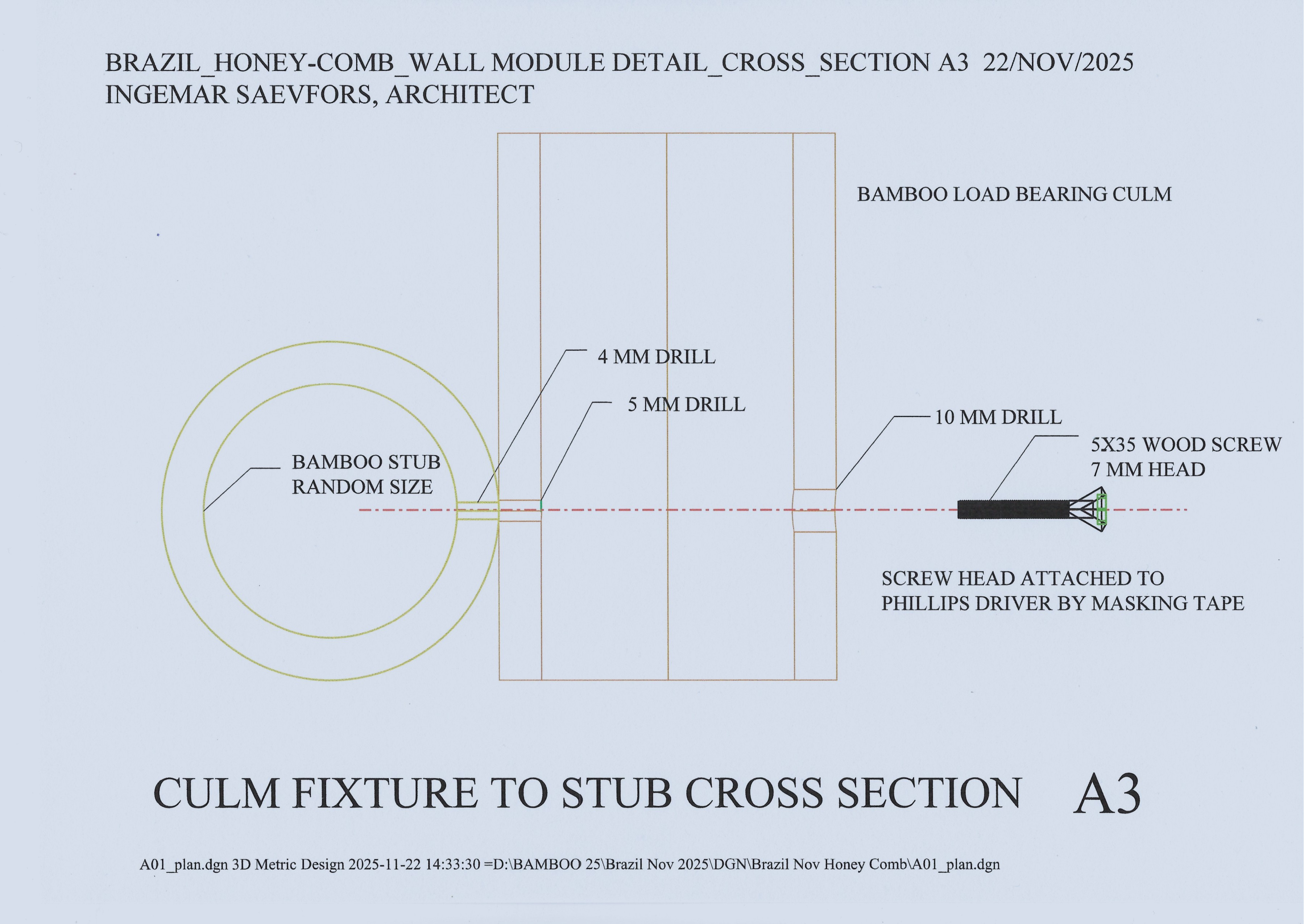
Cross Section: Fastening load-bearing culm to lined-up stub. Refer to "Centering" perspective.
After 1-2 days when the cement has hardened, the honey-comb wall module can be lifted and separated from the OSB-board-pool and the plastic film. The load bearing culm can now be fixed to the 3-4 stubs lined up.
All holes in the culm should be drilled from outside before assembly. The Ø10 mm holes first, then the Ø5 mm holes. To find their mirrored positions, a paper can be wrapped around the load bearing culm at the Ø10 mm hole. The culm circumference is measured and divided by 2 to mark the Ø5 mm hole. Finally, when the loadbearing culm has been positioned, the Ø4 mm holes are drilled in the receiving stubs.
To finalize everything, a 35xØ5 mm screw with a Ø7 mm large head is fixed to a Philips screwdriver with masking tape. Then it is entered through the 10 mm and the 5 mm holes to finally drive the screw into the 4 mm hole in the stub, here acting as a nut.
Preferably this culm should have been fixed at the center axis of the honeycomb wall module seen from above.
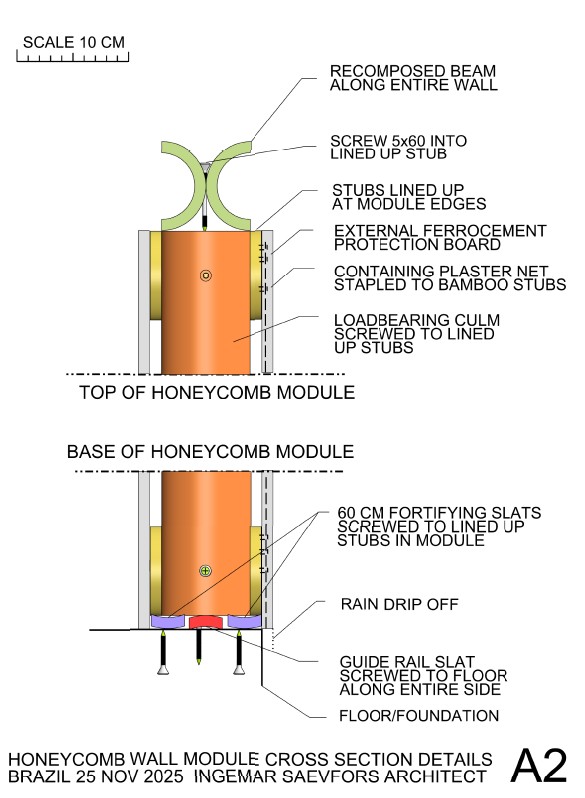
The bottom end of the honeycomb module should be fortified with 60 cm bamboo protective slats under both edges of the stubs, drilled and screwed. See detail cross section A2. Between those two slats there will be a guide rail, which is also a slat but fixed to the floor. This guide rail runs along the entire floor edge. This way the honeycomb module will fit snugly to the other adjacent modules.
Fig: Honeycomb wall panel cross-section with external ferro-cement skin protecting against rains, UV ( sun), fire hazards, mosquitos...Optional interior cladding.
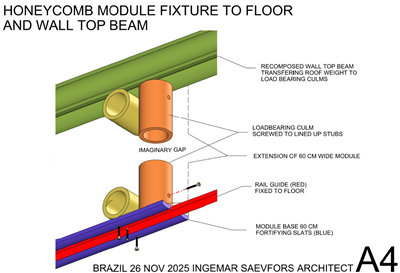
The red guiding rail has to be fixed to the concrete (presumably) floor before mounting the wall modules.
The upper side of the same module should be fixed to a recomposed beam, 6-8 cm high running over the entire wall, maybe 4-5 meters long. This fixture could be just a 6 cm screw going through the beam and then entering the lined-up stubs. After initial markings by a few turns of the drilling machine, Ø4 mm bore holes in the stubs may be necessary to avoid splitting by the screws.
This recomposed top beam distributes the weight of the roof structure down to the load bearing culms.