Use of tires as shock absorbers?

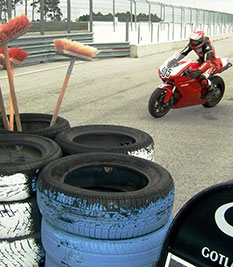
In races, piles of tires are protecting spectators from crashing vehicles.
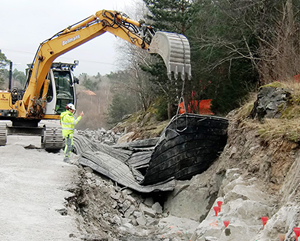
When blasting rocks in open air, mat assemblies of cut tires are used to protect against undesired destruction effects.
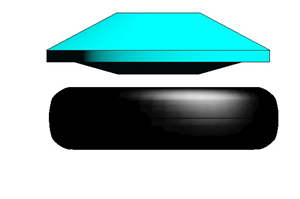
Elephant Foot prototype
The Elephant Foot
The concept is based on low cost construction techniques: old and worn out steel belted tires plus small quantities of concrete. In the bottom of the foundation ditches round river stones are placed to work as roller bearings. The tires are then placed side by side (without filling) to provide the elastic shock absorbing response. The Elephant Foot made of regular concrete is merged into the foundation tie beam via protruding reinforcement bars. The cone shaped bottom will make the structure center back into the tires after the quake.
Watch Youtube from Haiti: http://youtu.be/qvvUfwdXndo
Report test 2014, Haiti...Seismic shake table test, India
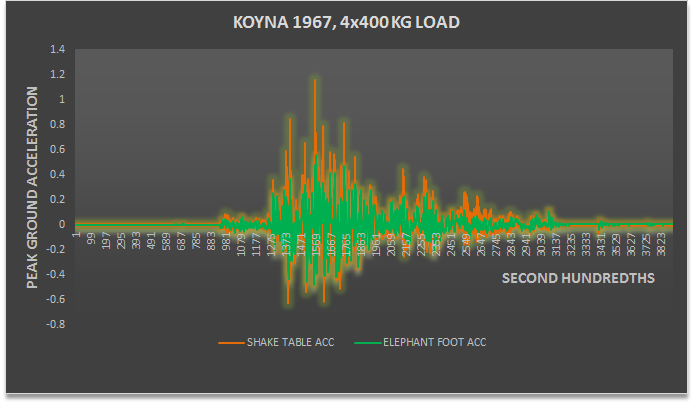
The concluding shake table tests February 2016 at the Indian Institute of Technology, Guwahati.
Shake table test IIT Guwahati, IndiaEvaluation UC Berkeley
Professor James Kelly, Department of Civil and Environmental Engineering, University of California, Berkeley: “…The results are consistently favorable and they get better as the carried load increases. There is always some reduction from table to specimen (Elephant Foot) never any amplification. But with higher load the reductions are excellent. I think you can consider these results as definitive and begin the process of bringing the concept to the attention of the authorities in Nepal… …I think you have got as much as you need from the shake table tests at Guwahati to publicize the system. Very best regards. JMK. ”
Live test in Haiti
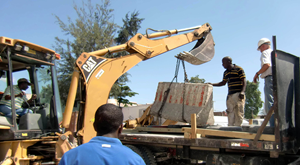
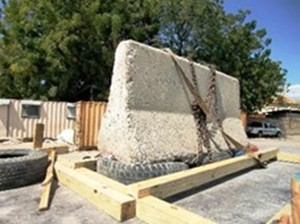
We built a solid wooden frame to keep the tires in place on a truck. The concrete weight was a road separation block weighing over 1.1 ton, which corresponds to a house wall on top of three tires in a row. The immediate evaluation of this first test series studying the video recordings: The concrete block was gently moving on top of the tires whereas the flatbed truck was shaking as expected on the unpaved road.
Important to note: the tires were not at all flattened by the weight of the concrete block, the three tires sustained easily 1.1+ ton, which corresponds well to the typical concrete hollow block house as can be seen in most low-income urban areas all over the world.